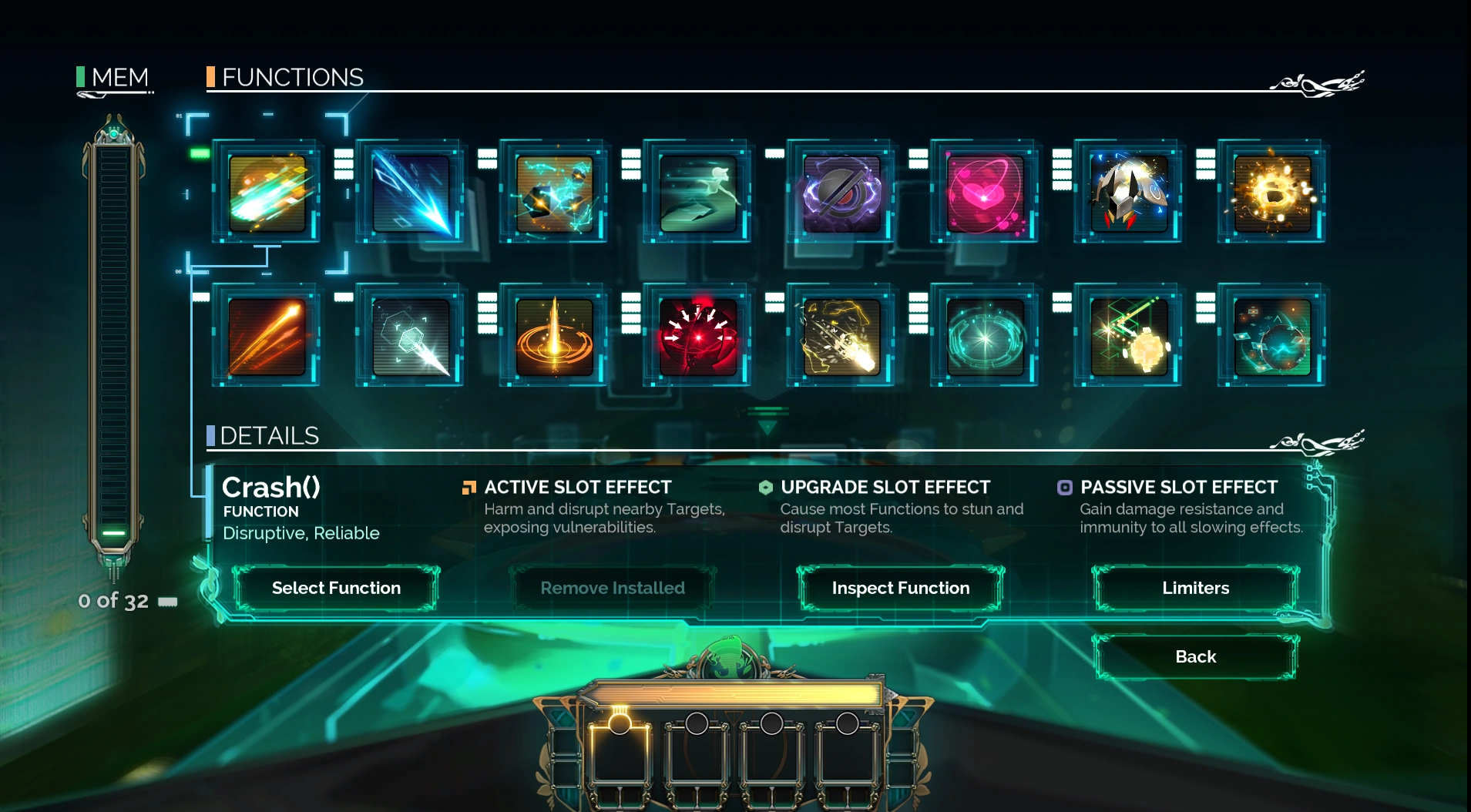
The Access Point screen displaying all currently available Functions
Functions are powers stored within the Transistor that a User can utilize during and outside combat. Most Functions are derived from the Traces of living or dead individuals.
Overview
The primary function innate to the Transistor is Turn(), which allows the User to freeze time, queue up other Functions and movements, and then execute that 'plan' in real-time. Most other Functions must be deliberately equipped to be used. Each equipped Function occupies a portion of the Transistor's available memory (MEM), and each can be equipped as an active Function, used to upgrade an active Function, or used to passively affect all equipped Functions. The Transistor's roster of unlocked Functions can be viewed or equipped at Access Points. Certain Limiters affect Functions.
Four active slots are available throughout the game; each has up to two upgrade slots in which other Functions can be equipped to upgrade the active ones, and up to four passive slots allow their Functions to passively affect all equipped Functions at the same time. Strategy includes selecting which Functions to use in each type of slot, learning adapting when one or more are temporarily unavailable.
Red is able to unlock access to Functions previously integrated by the Camerata, as well as more slots, MEM, and repeats of already acquired Functions via leveling up.
When Red signs in and becomes the Transistor's current User, Crash() and Breach() are preinstalled, which are hers and Unknown's respective Functions. These two Functions were added during Unknown's integration.
Derivation
Usable Functions can be derived from the Transistor coming into contact with the Trace of a Cloudbank citizen. This process may be conducted so as to leave the citizen intact, alive but damaged, or dead, and can also occur long after death if the citizen's Trace is still available near the body.
Sixteen of the Transistor's known Functions were derived from direct contact with Traces, while four other Functions become available through interactions between certain Trace-derived Functions. The only Function not associated with a Trace is Turn(), which allows the Transistor to pause time and queue up movements and attacks, enabling the user to pre-plan attacks against the Process. Turn() is a Function innate to the Transistor, and anyone wielding any Transistor can use Turn()s against opponents.
The Transistor records the Trace Status of each Function's parent Trace as intact, recorded, integrated, or non-recoverable. In most cases, though not all, no Function can be derived from a Trace too damaged to be recovered.
With one unique exception, Traces do not see, feel, or hear any use that is made of their Functions.
Slots
Functions can be applied to the Transistor in one of three types of slots: Active, Upgrade, or Passive.
- Installing a Function to an Active slot allows the User to use the Function's primary defined power. The User can gain access to up to four Active slots. The Transistor allows the User to install duplicate Functions in more than one Active slot.
- Installing a Function to an Upgrade slot makes the secondary Function modify the Active Function that it's applied to. The User can gain access to up to eight Upgrade slots, two per Active slot. The Transistor does not allow the User to install duplicate Functions as Upgrades to the same Active slot.
- Installing a Function to a Passive slot applies an effect to the User which is either always in-effect, or triggers automatically based on described circumstances. The User can gain access to up to four Passive slots. The Transistor does not allow the User to install duplicate Functions in Passive slots.
At the start of the game, the User has access to three Active slots, each with one Upgrade slot, and no Passive slots.
If Red runs out of health, the Function taking up the highest amount of Memory overloads, disabling it. (If this would remove Red's only means of dealing damage, the Function with the next highest Memory usage overloads instead.) The slot containing the next Function to overload is indicated by glowing wires that connect it to the health gauge. At the next Access Point, the player may uninstall the overloaded Function and choose another to install in its place, if available. Overloaded Functions are restored when the player visits two previously unvisited Access Points. If the Priority limiter is installed, this will only restore one overloaded Function at a time. If Red's last remaining installed Function overloads, Red dies and the game restarts from the most recently visited Access Point.
Function Files
Each equippable Function possesses a Function File containing passive demographic data on the person from whom the Function's Trace was taken. Available Function Files can be viewed at any Access Point, whether or not the Function has recently been lost.
Basic Function File information, including the subject's name, image, Selections, and other brief demographic data, can be seen immediately upon unlocking the Function. Each Function File also has three sections of text which can only be seen after the Function has been installed and used in battle. To completely decrypt a Function File's three available sections, the respective Function must be used in each type of slot at least once.
Function Files contain information on the Traces left by people integrated into the Transistor. Each File provides background information on the source of its associated Trace and what their life was like prior to their integration at the hands of the Camerata. Upon the first time a Function File is viewed outside of the influence of the Spine, even if no sections have been unlocked, Unknown makes a brief remark about the person's history.
Unlike Function Files, the unlockable data associated with Limiters consists of a single informational note left there by Royce Bracket.
List of Functions
There are sixteen equippable and four unequippable Functions.
The following Functions can be unlocked and equipped by the User:
- Bounce(), derived from Niola Chein's Trace.
- Breach(), derived from Unknown's Trace.
- Crash(), derived from Red's Trace.
- Cull(), derived from Olmarq's Trace.
- Flood(), derived from Royce Bracket's Trace.
- Get(), derived from Bailey Gilande's Trace.
- Help(), derived from Sybil Reisz's Trace.
- Jaunt(), derived from Preston Moyle's Trace.
- Load(), derived from Wave Tennegan's Trace.
- Mask(), derived from Shomar Shasberg's Trace.
- Ping(), derived from Henter Jallaford's Trace.
- Purge(), derived from Maximilias Darzi's Trace.
- Spark(), derived from Lillian Platt's Trace.
- Switch(), derived from Farrah Yon-Dale's Trace.
- Tap(), derived from Grant Kendrell's Trace.
- Void(), derived from Asher Kendrell's Trace.
The following Functions are unique and unequippable, only accessible in specific circumstances:
- Check(), available only when Cull() is equipped in a Passive Slot.
- Bark(), available only to Friendly Fetches spawned via Help().
- Sic(), the Friendly Fetches' equivalent of Check(), available only when Cull() is equipped as an upgrade to Help().
- Kill(), available only when the User is granted SuperUser access via Help().
Trivia
- It is implied that the Functions are not primarily intended to be used in combat, as there is no mention of the Camerata using the Transistor as such prior to Royce's showdown with Red.
- Once all equippable Functions are acquired, looking at them with an Access Point for the first time causes Unknown to remark that the gang's all here.
- In Recursion, the Traces of individuals such as Lillian Platt and Sybil Reisz must be integrated in order to progress, but do not provide duplicates of their Functions. Duplicate Functions become an option after all equippable Functions are acquired, whereupon leveling up provides a choice between four Functions the player already has and choosing one unlocks an extra version of the Function. Duplicates of the same Function can be equipped up to three times, including as an upgrade to a duplicate of itself, although there can be only one passive, upgrade, and active instance of the same Function equipped at the same time.
- Also in Recursion, if Red's health bar reaches zero in any battle before she reaches the game's first Access Point, a brief "Transistor Overloaded" message appears, but no Functions are overloaded. This may serve to compensate for the fact that Red must face multiple high-powered groups of enemies with the same array of equipped Functions from the previous run's final battle before an opportunity arises for the player to adjust the Transistor's build. After the first Access Point, Function overload occurs as before.
- Although Royce Bracket wrote the info notes on the Limiters, he could not have written the Function Files; he did not have access to the Transistor after Red's Trace was acquired, and Sybil's contained information which she did not reveal to the Camerata. The sparse information presented in Unknown's Function File and the vanity evident in Royce's, along with allusions to sources such as diary entries, private conversations, and public records about career and Selection choices, suggests that Function File data is assembled from public and private data held within Cloudbank's infrastructure and associated with the individual's Trace during integration. Administrative efforts by Grant and Asher to suppress such information about the Camerata is likely to have contributed to the oblique references to the organization in their victims' Files.
Related Achievements
| Icon | Name | How to Obtain |
|---|---|---|

|
Search() | Inspect 5 completed Function Files. |

|
Find() | Inspect 10 completed Function Files. |

|
Reveal() | Inspect all completed Function Files. |

|
Memory() | Unlock 32 MEM. |

|
User() | Unlock every Upgrade Slot and Passive Slot. |
|
Function() | Unlock every Transistor Function. |

|
Stack() | Create a Function combination requiring 12 MEM. |
|
Self() | Upgrade a Function with a copy of itself. Only available in Recursion. |
- List of Achievements
| Functions |
|---|


